Plan Smarter. Grow Stronger. Don’t miss our latest financial strategies. →
Read the latest blog posts.png)
January 5, 2026
What Nobody Tells You About Financial Independence Before You Start
Here's what they show you:
The laptop on the beach. The "I quit my job" post. The smiling face with the caption: "Living my best life—finally free."
Financial independence looks like a destination. A finish line. The moment you hit your number, crack open the champagne, and ride off into the sunset of perpetual vacation.
Here's what they don't show you:
The three years of saying "no" to trips your friends took. The spreadsheets at 11 PM. The deals that fell through. The self-doubt. The months where the cash flow was tight and you wondered if you were crazy for trying.
And here's what nobody mentions at all:
Financial independence doesn't feel the way you think it will.
It's not a light switch. It's not euphoric. And the freedom you're chasing? It comes with a whole new set of questions you didn't see coming.
I'm not saying this to discourage you. I'm saying it because knowing what's actually ahead makes you far more likely to get there—and stay there.
So let's talk about the things nobody tells you before you start this journey.
1. Financial Independence Is Boring (And That's the Point)
You think it's going to be exciting. Exotic. Instagram-worthy.
The reality?
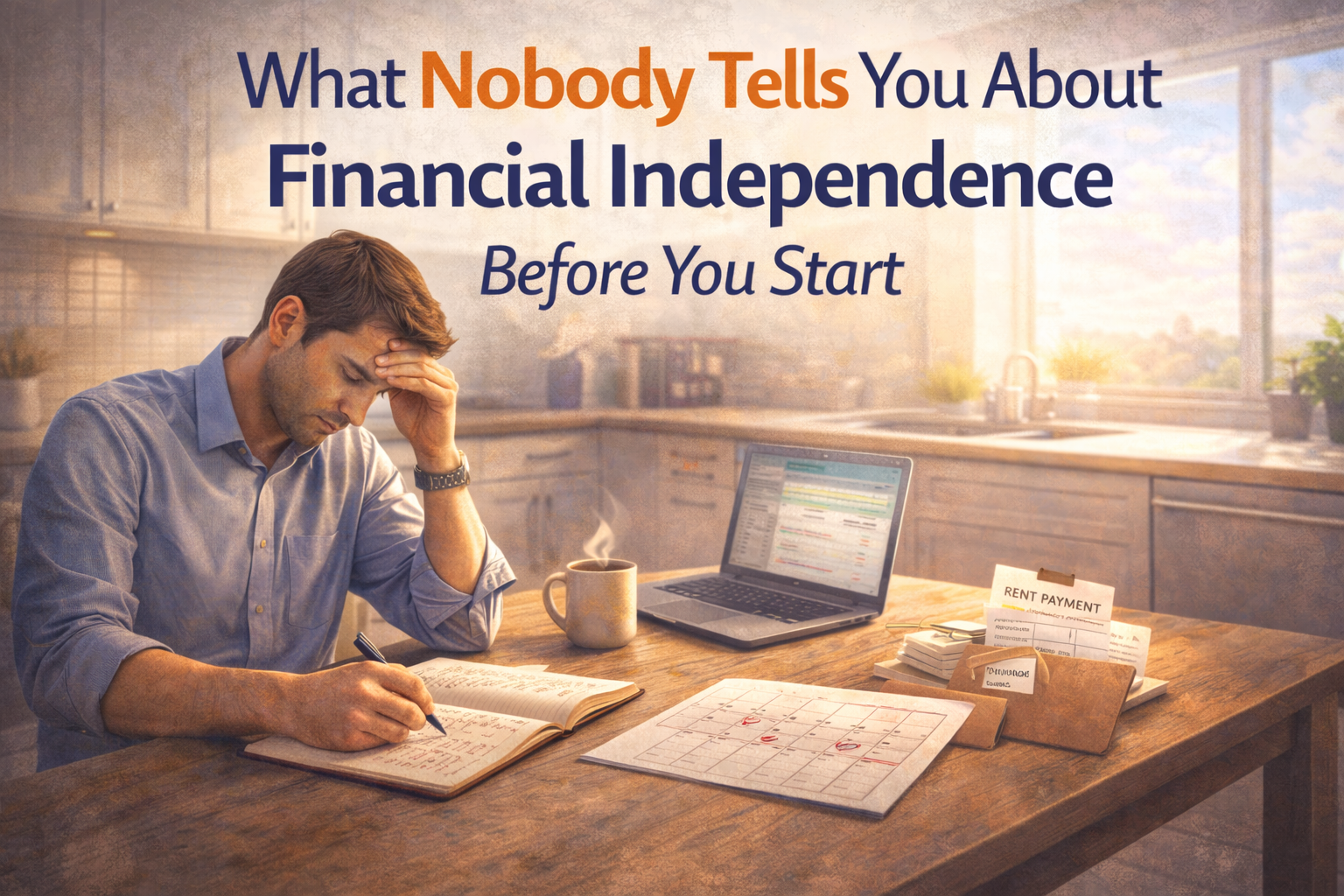
It's a Tuesday afternoon and you're sitting at your kitchen table. You check your bank account and see the rent deposit from your tenant. You glance at your brokerage and see the dividend hit. You realize you didn't do anything to earn that money—it just showed up.
And you feel... nothing. Because it's normal now.
That's the point.
Financial independence isn't adrenaline. It's absence —absence of stress, absence of urgency, absence of fear.
It's waking up and realizing you don't have to do anything today. You can if you want. But you don't have to.
The freedom isn't loud. It's quiet.
And if you're chasing FI because you think it's going to be a constant high, you're going to be disappointed.
But if you're chasing it because you want your Tuesdays back? You're going to love it.
2. The First 25% Is Harder Than the Last 75%
Everyone talks about "hitting your number." But nobody talks about how brutal the first chunk is.
Here's why:
When you start, every dollar of passive income feels impossible:
- You save $50K for a down payment and it takes two years
- You buy your first rental and it cash flows $300/month
- You look at your $6,000/month expenses and think: "I need 20 of these?!"
The math feels insurmountable.
But here's what happens:
- Property #1 takes 2 years to acquire
- Property #2 takes 18 months (you're better at it now)
- Property #3 takes 12 months (you have systems, lenders, a team)
- Property #4 takes 8 months (you're using cash flow from #1–3 to accelerate)
The first 25% of your goal takes 50% of the time. The last 75% happens faster than you think.
Because compounding isn't just about returns—it's about momentum, skills, confidence, and systems.
The hardest part is starting. The second hardest part is not quitting in year two.
If you can survive the first 25%, the rest is inevitable.
3. You'll Lose Friends (And That's Okay)
This one stings, but it's real.
When you start prioritizing financial independence, your life changes:
- You stop going to every happy hour
- You skip the destination bachelor party
- You say "no" to the $200 dinner
- You drive the paid-off car while your friends lease new ones
At first, people get it. Then they get annoyed. Then they stop inviting you.
Because your choices make them uncomfortable.
Not because you're judging them—but because your discipline reflects their lack of it. Your "no" reminds them of their "yes." Your progress highlights their stagnation.
You'll lose some friends. You'll gain new ones.
The people who are building what you're building. The people who get it. The ones who don't need to spend money to have a good time.
Financial independence is a filter—and that's a feature, not a bug.
4. The Goal Isn't to Stop Working—It's to Start Choosing
Here's the fantasy:
"Once I hit financial independence, I'll never work again. I'll travel the world, sleep in, do whatever I want."
Here's the reality:
Most people who achieve FI keep working. They just work differently.
- They take the lower-paying job they actually enjoy
- They start the business they always wanted to try
- They consult part-time, on their terms
- They volunteer, mentor, create
Because humans need purpose. And purpose often looks like work—just work you choose, not work you're forced into.
Financial independence doesn't mean you stop contributing. It means you stop trading time for survival and start trading time for meaning.
The goal isn't retirement. It's optionality.
5. Your "Number" Will Change (And That's Normal)
You start with a target:
"I need $5,000/month in passive income to cover my expenses. That's my number."
You build toward it. You sacrifice for it. You hit it.
And then...
- Your kid needs braces
- Your car dies
- You want to travel more
- Your health insurance goes up
- You realize you want a buffer
Your number moves.
And that's okay. Because financial independence isn't a fixed point—it's a range. A margin of safety. A cushion that lets you breathe.
Don't get paralyzed by perfection. Build toward "enough," then keep building toward "more than enough."
The people who quit at "barely enough" often slide backward. The people who build past their number sleep better.
6. The Hard Part Isn't the Money—It's the Identity Shift
For your entire adult life, you've been defined by what you do:
"I'm a software engineer."
"I'm a consultant."
"I'm a director at XYZ company."
Your job is your identity. Your title is your introduction. Your career is your story.
And then you hit financial independence and suddenly... you're not that anymore.
Who are you when you're not your job?
This is the crisis nobody warns you about.
Some people spiral. Some people go back to work because they can't handle the void. Some people realize they never actually wanted freedom—they wanted validation.
The people who thrive are the ones who figured out their identity before they hit FI.
They know what they're building toward. They know what they'll do with their time. They know who they are beyond their paycheck.
Financial independence gives you freedom. But you have to know what to do with it.
7. It's Lonelier Than You Think (Until You Find Your People)
Most people don't get it.
They don't understand why you're "obsessed" with saving. Why you're buying rental properties instead of going to Coachella. Why you're analyzing spreadsheets on a Saturday morning.
They think you're weird. Extreme. Missing out.
And for a while, you'll feel isolated.
But then you find your people:
- The online communities
- The local real estate meetups
- The mastermind groups
- The people who are building the same thing
And suddenly, you're not weird—you're normal.
You're surrounded by people who get it. Who celebrate your wins. Who understand the sacrifices. Who are on the same path.
Financial independence is a lonely road—until you find the others walking it with you.
8. The Best Part Isn't What You Gain—It's What You Lose
You think financial independence is about what you get:
- Freedom
- Time
- Options
- Security
But the best part? It's what you lose :
- The Sunday night dread
- The alarm clock anxiety
- The "I have to check with my boss" feeling
- The fear of getting laid off
- The resentment of trading time for money
Financial independence isn't about adding things to your life. It's about removing the things that were stealing it.
And that absence—that quiet, boring, unremarkable absence of stress—is worth every sacrifice you made to get there.
Here's the Truth:
Financial independence isn't a fairy tale. It's not a hack. It's not a get-rich-quick scheme.
It's a long, boring, unglamorous slog that requires discipline, sacrifice, and patience.
But it's also the most worthwhile thing you'll ever build.
Because on the other side of that slog is a life where you own your time. Where you make decisions based on what you want, not what you can afford. Where money is a tool, not a master.
And nobody can take that from you.
Ready to start building—with people who actually get it?
The Financial Freedom Accelerator is an 8-week, live coaching experience that takes you from "thinking about it" to "doing it"—with a clear plan, expert guidance, and a community of people on the same path.
Led by investor and mentor Erik Hitzelberger, this isn't just education. It's implementation. You'll learn how to acquire cash-flowing assets, reduce your taxes, and build a roadmap to financial independence that actually works.
Learn More About Financial Freedom Accelerator
Because financial independence isn't a destination.
It's a decision—and a daily practice.
And it starts now.

.jpg)

Book Your Freedom Call

Client Success First
FPG Academy has taught entire groups of people and individuals how to think differently about money and investing.

Done-with-You Financial Options
We tailor every plan to your unique goals, ensuring you always receive the education that fits your goals.
.svg)
Clear, Ongoing Support
With interactive courses, supportive digital products, and access to educators within FPG Academy, we make sure all your questions get answered.
© 2025 FPG Academy All rights reserved.
Website design by My Launch Partner.svg)
.svg)
.svg)