Plan Smarter. Grow Stronger. Don’t miss our latest financial strategies. →
Read the latest blog posts.png)
December 8, 2025
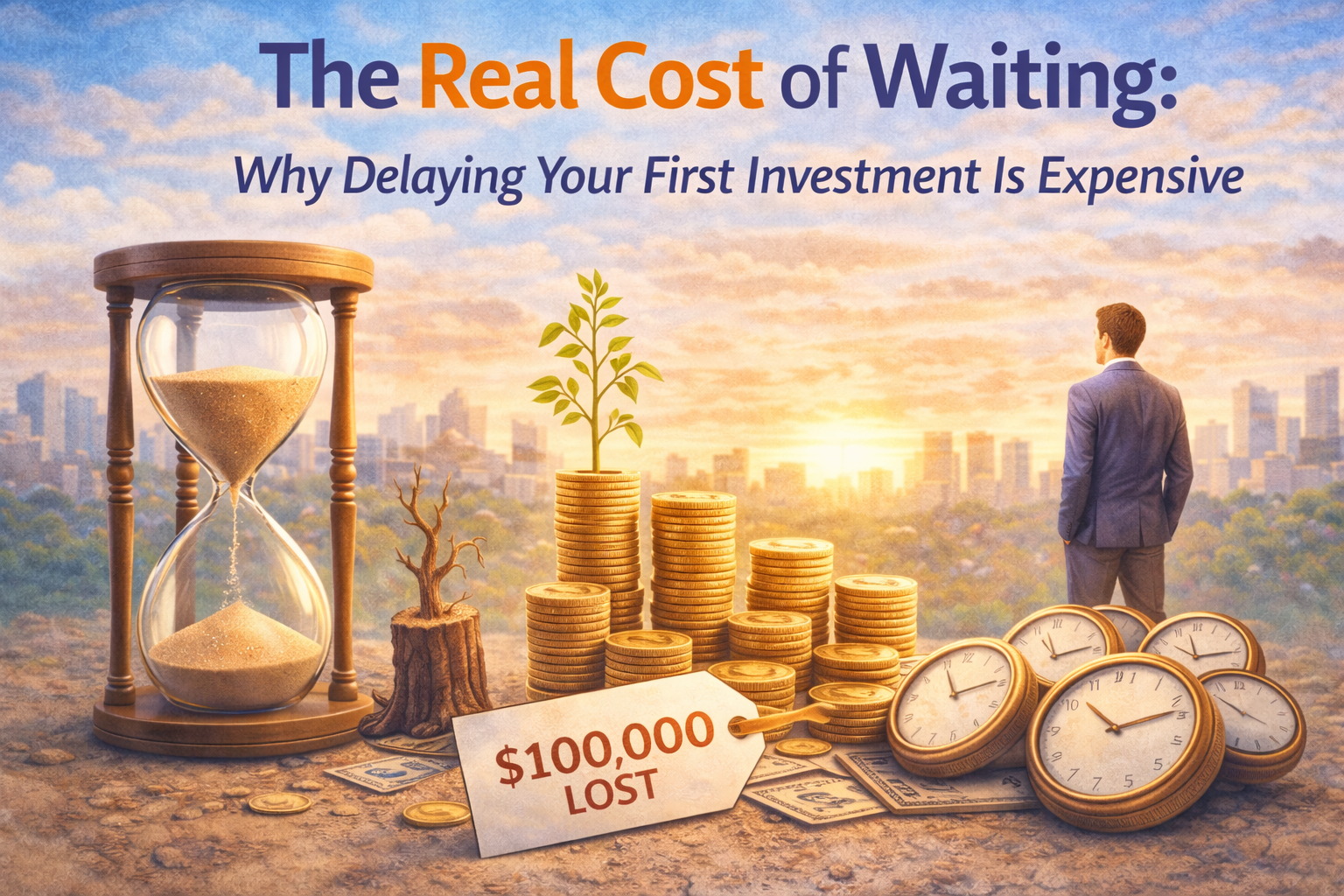
The Real Cost of Waiting: Why Delaying Your First Investment Is Expensive
You're going to do it.
You've been saying it for months—maybe years. You're going to buy that rental property. Start that brokerage account. Make that first real investment outside your 401(k).
You just need to:
- Read one more book
- Listen to a few more podcasts
- Wait for the "right time"
- Save a little more cash
- Get through this busy season at work
- Make sure you really understand it first
And look—being cautious is smart. Doing your homework is responsible. Nobody's saying you should YOLO your life savings into something you don't understand.
But here's what nobody tells you:
Waiting has a price tag. And it's bigger than you think.
Every month you delay isn't just a month of standing still. It's a month of lost compounding, lost cash flow, lost tax benefits, and lost time you can never get back.
Let's talk about what waiting is actually costing you—and why "being ready" might be the most expensive mistake you never knew you were making.
The Myth of the "Perfect Time"
Here's the story you tell yourself:
"I'll invest when I have more saved."
"I'll buy real estate when the market corrects."
"I'll start when I'm less busy."
"I'll pull the trigger when I feel more confident."
And all of those sound reasonable. Logical, even.
But here's the truth:
There is no perfect time. There's only time passing.
- The market you're waiting to "correct" might run up another 20% before it dips 10%
- The cash you're waiting to save is losing 3–5% per year to inflation while it sits
- The "busy season" never actually ends—it just becomes a different kind of busy
- The confidence you're waiting for only comes after you do the thing, not before
Translation: Waiting for perfect is just procrastination with better PR.
What Waiting Actually Costs You (Let's Do the Math)
Let's say you're 35 years old. You have $50K saved for your first investment property. You're "almost ready"—you just want to wait a little longer.
Scenario 1: You invest today
- You buy a $250K rental property with $50K down
- It cash flows $400/month after all expenses
- It appreciates 3% per year (conservative)
- You hold it for 10 years
Results at age 45:
- You've collected $48,000 in cash flow ($400/month × 120 months)
- The property is now worth $336,000 (3% annual appreciation)
- Your equity (after paying down the mortgage) is roughly $140,000
- You've taken $30K+ in depreciation deductions, saving you $7,500–$10,500 in taxes
Total wealth created: ~$195K–$200K
Scenario 2: You wait 3 years to "be sure"
Same property, same numbers—you just start 3 years later.
Results at age 45:
- You've collected $33,600 in cash flow ($400/month × 84 months)
- The property is now worth $296,000 (7 years of appreciation instead of 10)
- Your equity is roughly $95,000
- You've taken fewer depreciation deductions, saving less in taxes
Total wealth created: ~$135K–$140K
Cost of waiting 3 years: $55K–$65K
And that's just one property. If you'd bought two, or reinvested the cash flow, the gap would be even wider.
But It's Not Just About the Money
The financial cost is real. But the life cost is even bigger.
1. You lose compounding time
Compounding isn't just about returns—it's about time . The earlier you start, the more time your money has to grow, multiply, and work for you.
Waiting 5 years to start doesn't mean you're 5 years behind. It means you lost 5 years of compounding—which could be 10–20 years' worth of growth by the time you retire.
2. You stay dependent on your paycheck longer
Every month you delay building passive income is another month you have to work.
If your goal is to replace your income with cash flow by age 50, waiting until 40 to start means you're trying to do in 10 years what you could have done in 15.
Translation: Waiting doesn't just delay freedom—it makes it harder to achieve.
3. You reinforce the fear
The longer you wait, the scarier it gets. The bigger the decision feels. The more reasons you find to delay.
Confidence doesn't come from reading more—it comes from doing . And every month you wait is another month you're training yourself to stay stuck.
4. You miss the learning curve
Your first investment won't be perfect. You'll make mistakes. That's part of the process.
But the sooner you start, the sooner you learn. The sooner you learn, the sooner you get better. The sooner you get better, the sooner you scale.
Waiting to be "perfect" just delays the inevitable learning curve—it doesn't eliminate it.
The 3 Lies That Keep You Waiting
Lie #1: "I need to save more first."
The truth: You'll never feel like you have "enough" saved. There will always be another expense, another goal, another reason to wait.
If you have enough for a down payment and 6 months of reserves, you're ready. The rest is just fear dressed up as prudence.
Lie #2: "I need to know everything before I start."
The truth: You can't learn to swim by reading about swimming. You learn by getting in the water.
Yes, do your homework. But at some point, education without execution is just expensive procrastination.
Lie #3: "The market's too high / too uncertain / too risky right now."
The truth: There's always a reason to wait. Always.
- 2008: "The market just crashed."
- 2012: "It's too early in the recovery."
- 2015: "Prices are getting too high."
- 2020: "There's a pandemic."
- 2022: "Interest rates are rising."
- 2025: "It's an election year / rates are still high / the market's uncertain."
The people who build wealth don't wait for perfect conditions. They act in imperfect conditions with smart strategy.
So What Do You Do Instead?
Step 1: Set a decision deadline.
Not "someday." Not "when I'm ready."
Pick a date—60 days, 90 days, 6 months—and commit to making a decision by then. Research, analyze, consult, plan—but decide .
Step 2: Start small if you need to.
You don't have to buy a $500K property tomorrow. You can:
- Invest $10K in a real estate syndication
- Buy $5K worth of dividend stocks in a taxable account
- Partner with someone on a deal to learn the ropes
- House hack (live in one unit, rent out the others)
The goal isn't to go big—it's to go.
Step 3: Build your team before you need them.
- Find a lender and get pre-approved
- Connect with a real estate agent who works with investors
- Talk to a CPA who understands real estate tax strategy
- Join a community of people who are doing what you want to do
When you have the infrastructure in place, the decision becomes easier.
Step 4: Underwrite deals—even if you're not buying yet.
Practice analyzing properties. Run the numbers. Submit offers (even if they don't get accepted).
The reps build confidence. And confidence kills hesitation.
Step 5: Shift from "What if I fail?" to "What if I don't try?"
The risk isn't making a mistake. The risk is getting to 50, 60, 70 and realizing you spent your whole life preparing to do something you never actually did.
Here's the Truth:
Waiting feels safe. But it's not.
Because while you're waiting for the perfect time, the perfect knowledge, the perfect confidence—time is passing. Compounding is happening. Opportunities are moving.
And the cost of waiting isn't just financial.
It's the life you could have lived. The freedom you could have built. The version of yourself you never became because you were too busy getting ready.
You don't need to be perfect. You need to start.
Ready to stop waiting and start building?
The Financial Freedom Accelerator is an 8-week, live coaching experience that takes you from "thinking about it" to "doing it."
You'll learn how to analyze deals, secure financing, build a tax strategy, and acquire your first cash-flowing asset—with a mentor who's done it and a community doing it with you.
No more research paralysis. No more "I'll start next year."
Just a clear plan, accountability, and execution.
Learn More About Financial Freedom Accelerator
Because the best time to start was five years ago.
The second-best time is today.
.jpg)

Book Your Freedom Call

Client Success First
FPG Academy has taught entire groups of people and individuals how to think differently about money and investing.

Done-with-You Financial Options
We tailor every plan to your unique goals, ensuring you always receive the education that fits your goals.
.svg)
Clear, Ongoing Support
With interactive courses, supportive digital products, and access to educators within FPG Academy, we make sure all your questions get answered.
© 2025 FPG Academy All rights reserved.
Website design by My Launch Partner.svg)
.svg)
.svg)