Plan Smarter. Grow Stronger. Don’t miss our latest financial strategies. →
Read the latest blog posts.png)
November 10, 2025
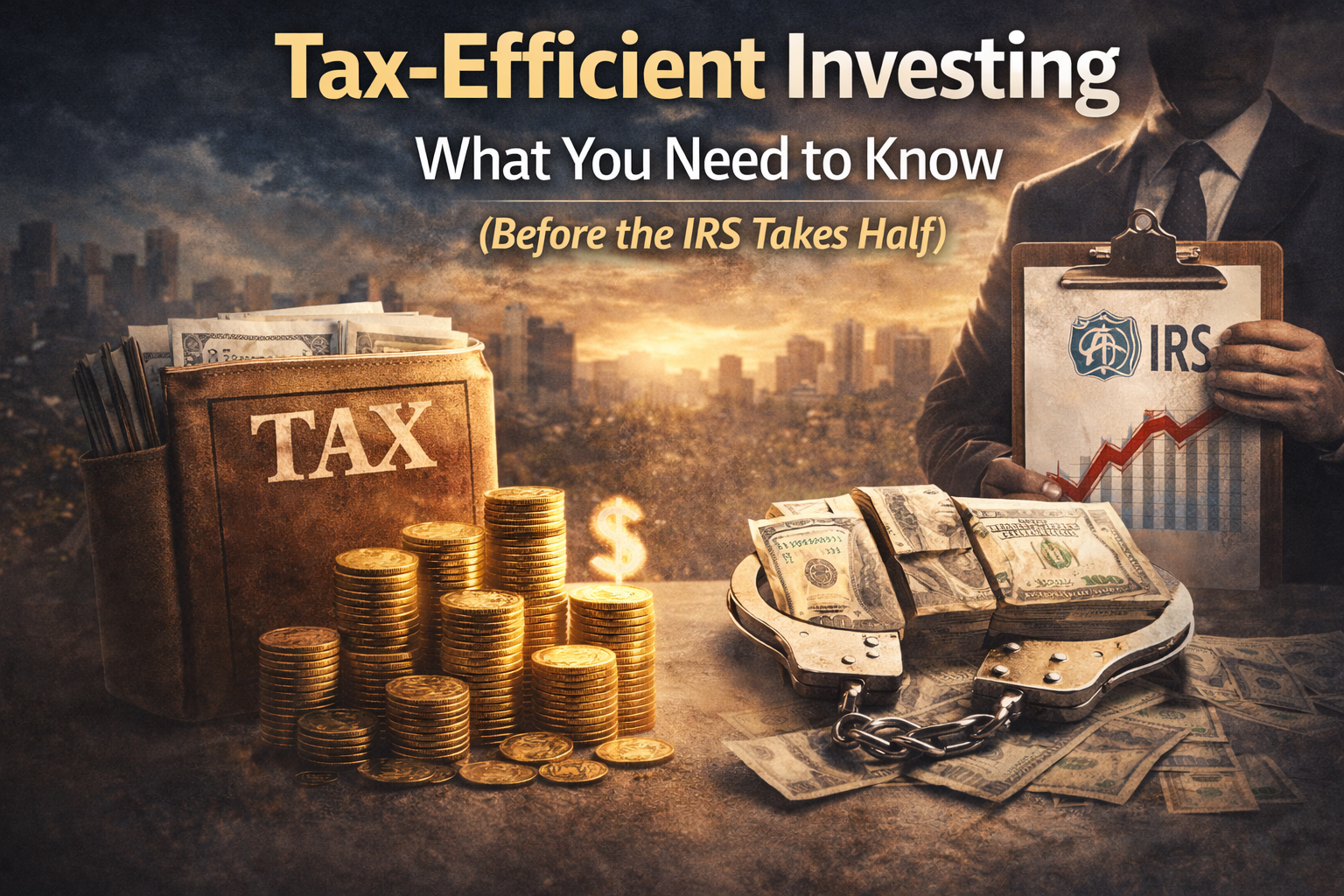
Tax-Efficient Investing: What You Need to Know (Before the IRS Takes Half)
You've done everything right.
You're maxing out your 401(k). You're contributing to your IRA. Your brokerage account is growing. On paper, you're building wealth.
But here's the part nobody talks about in those glossy retirement brochures:
The IRS is your silent partner—and they're taking a bigger cut than you think.
Because it's not about how much you make. It's about how much you keep after taxes. And if you're not thinking about tax efficiency now, you're essentially working overtime… for the government.
Most high earners are so focused on growing their accounts that they forget to ask the most important question:
"How much of this is actually mine?"
Let's fix that.
The Problem With "Tax-Deferred" (Hint: It's Still Taxed)
You've been told your whole career: "Max out your 401(k). Lower your taxable income. Let it grow tax-deferred."
And that's not wrong —it's just incomplete.
Here's what happens in reality:
- You contribute pre-tax dollars today (feels good)
- The account grows for 20–30 years (looks great on statements)
- You retire and start withdrawing (finally!)
- The IRS taxes every single dollar —including all the growth—as ordinary income
Translation: You delayed the tax bill. You didn't eliminate it. And depending on your tax bracket in retirement, you might actually pay more than if you'd paid taxes upfront.
Oh, and if tax rates go up between now and then? You just locked in a future tax hike on your own money.
Tax deferral isn't a strategy. It's a gamble.
What Tax-Efficient Investing Actually Means
Tax efficiency isn't about avoiding taxes (that's illegal). It's about legally minimizing what you owe so more of your wealth stays in your pocket and works for you.
Here's the difference:
Tax-Inefficient Investor:
- Contributes to 401(k), pays taxes later at unknown rates
- Holds investments in taxable accounts, pays capital gains every time they rebalance
- Takes no deductions, no offsets, no strategy
- Retires and gets hit with RMDs (Required Minimum Distributions) that spike their tax bracket
Tax-Efficient Investor:
- Balances pre-tax, Roth, and taxable accounts strategically
- Uses real estate depreciation to offset W-2 income
- Harvests losses to reduce capital gains
- Plans withdrawals to stay in lower brackets
- Builds wealth that compounds after-tax , not before
The result? Two people with the same income can end up with vastly different actual wealth—because one planned for taxes, and the other hoped they'd figure it out later.
5 Tax-Efficient Strategies You Should Know (And Use)
1. Max Out Your Roth Options (The Money You'll Actually Keep)
What it is: Roth 401(k) and Roth IRA contributions are made with after-tax dollars, but all future growth and withdrawals are tax-free .
Why it matters: You pay taxes now (when you know the rate) and never again. No RMDs. No tax bombs in retirement. No wondering what Congress will do in 30 years.
Who should do this: High earners in their peak earning years who expect taxes to rise, or anyone who wants tax-free income in retirement.
Action step: If your employer offers a Roth 401(k), start shifting contributions. If you're eligible for a Roth IRA, fund it. If you're over the income limit, look into a backdoor Roth conversion.
2. Use Real Estate to Offset Your W-2 Income
What it is: Real estate investors can use depreciation (a non-cash expense) to reduce taxable income—sometimes to zero.
Why it matters: You can make money, pay little to no tax on it, and reduce taxes on your W-2 income if you qualify as a real estate professional or use cost segregation strategies.
Example:
- You buy a $300K rental property
- Cost segregation study accelerates $60K in depreciation in year one
- That $60K offsets your W-2 income
- You just saved $15K–$20K in taxes (depending on your bracket)
Who should do this: High earners looking to reduce taxable income while building cash-flowing assets.
Action step: Talk to a CPA who understands real estate tax strategy. If you're serious about tax efficiency, this is one of the most powerful tools available.
3. Harvest Tax Losses (Turn Market Dips Into Tax Wins)
What it is: Selling investments at a loss to offset capital gains (and up to $3K of ordinary income per year).
Why it matters: Markets go down. Instead of just watching your account shrink, you can lock in losses to reduce your tax bill—then reinvest in similar (but not identical) assets.
Example:
- You have $10K in capital gains from stock sales
- You also have $10K in unrealized losses in another position
- You sell the losing position, offset the gains, and owe $0 in capital gains tax
- You reinvest the proceeds into a similar asset
Who should do this: Anyone with a taxable brokerage account.
Action step: Review your taxable accounts quarterly. Look for opportunities to harvest losses, especially in down markets. Just avoid the "wash sale" rule (don't buy the same security within 30 days).
4. Be Strategic About Where You Hold Investments
What it is: Different accounts have different tax treatments. Putting the right investments in the right accounts can save you thousands.
The strategy:
Tax-advantaged accounts (401(k), IRA, Roth):
- Bonds and REITs (taxed as ordinary income)
- Actively traded stocks (high turnover = high taxes)
Taxable brokerage accounts:
- Index funds (low turnover, lower taxes)
- Stocks you hold long-term (qualified dividends, long-term capital gains)
Why it matters: Ordinary income is taxed higher than long-term capital gains. By placing high-income assets in tax-deferred accounts and growth assets in taxable accounts, you minimize your overall tax drag.
Action step: Audit your accounts. Make sure you're not holding tax-inefficient assets (like bonds) in taxable accounts where they'll get hammered every year.
5. Plan Your Retirement Withdrawals Like a Chess Game
What it is: The order and timing of your withdrawals in retirement can dramatically affect your tax bill.
Why it matters: If you withdraw everything from your 401(k) at once, you'll spike into higher tax brackets. If you're strategic, you can stay in lower brackets and keep more.
The strategy:
- Withdraw from taxable accounts first (already taxed, lower rates on gains)
- Let Roth accounts grow as long as possible (tax-free forever)
- Use pre-tax accounts strategically to fill up lower tax brackets without jumping into higher ones
- Consider Roth conversions in low-income years (pay tax now at a lower rate)
Who should do this: Anyone within 10 years of retirement (or already there).
Action step: Model your retirement income sources with a tax-aware financial planner. A good withdrawal strategy can save you six figures over a 30-year retirement.
The One Question Your Financial Advisor Should Be Asking (But Probably Isn't)
"How much of this will you actually keep after taxes?"
If your advisor is only talking about returns and account balances, they're giving you half the picture.
Because a 7% return that gets taxed at 35% is really a 4.55% return.
And a 5% return that's tax-free? That's actually worth more.
Tax efficiency isn't an advanced strategy. It's table stakes.
Here's the Truth:
You can't control the market. You can't control inflation. But you can control how much the IRS takes.
And every dollar you save in taxes is a dollar that compounds for you —not the government.
Tax-efficient investing isn't about being cheap or cutting corners. It's about being intentional . It's about building wealth that's actually yours.
Because financial freedom isn't just about making money.
It's about keeping it.
Ready to build a plan that grows your wealth and protects it from unnecessary taxes?
Join the Financial Freedom Accelerator. An 8-week course led by Erik Hitzelberger to get you crystal clear on your current financial situation, where you want to be, and how saving more of your money will get you there faster.
Because the best investment you can make isn't in the market.
It's in a strategy that lets you keep what you earn.

.jpg)

Book Your Freedom Call

Client Success First
FPG Academy has taught entire groups of people and individuals how to think differently about money and investing.

Done-with-You Financial Options
We tailor every plan to your unique goals, ensuring you always receive the education that fits your goals.
.svg)
Clear, Ongoing Support
With interactive courses, supportive digital products, and access to educators within FPG Academy, we make sure all your questions get answered.
© 2025 FPG Academy All rights reserved.
Website design by My Launch Partner.svg)
.svg)
.svg)